
Location: Salzburg, Austria
Dates: 28th-29th of October 2022

Location: Salzburg, Austria
Dates: 28th-29th of October 2022
SiN-EV annual meeting will be held in person in Ljubljana on Monday, June 20th 2022.
Two distinguished lecturers already confirmed their attendance:
– Prof. Edit Buzás (Semmelweis University, Hungary), one of the leading researchers in the EV field and the presumed president of the International Society for EVs, ISEV, and the president of the Hungarian Society for EVs
– Wolfgang Holnthoner (Ludwig Boltzmann Institute for Traumatology; Austria), president of the Austrian Society for EVs, ASEV
There will also be ample opportunities for members of SiN-EV to present their research.
More information to follow.
SiN-EV has joined the European initiative MOVE (MObility for Vesicles research in Europe), established to foster collaboration between the members of different European EV Societies and Networks. The current project of the initiative is MOVE European Mobility Fellowship, which enables short-term (1-3 months) visits of early-stage scientists – technicians, doctoral students, and young postdoctoral students – involved in the research of extracellular vesicles to other European laboratories.
More information about laboratories involved in the initiative and application process can be found at: https://www.ukev.org.uk/move-mobility-ev-europe/.
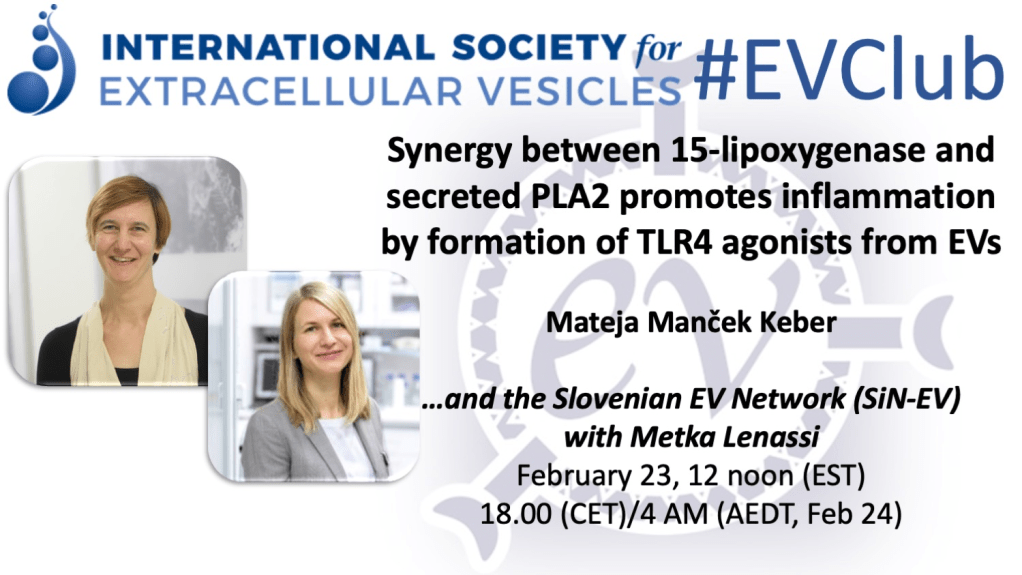
This week, #EVCLub is a collaboration with the Slovenian EV Network (SiN-EV):
Mateja Manček Keber presents “Synergy between 15-lipoxygenase and secreted PLA2 promotes inflammation by formation of TLR4 agonists from EVs” https://www.pnas.org/content/117/41/25679.
Login Wednesday, Feb 23, 12 noon EST/18.00 CET/4 AM AEDT (Feb 24) here: https://jhjhm.zoom.us/j/99677696469?pwd=NXUvSDlMSW9tVnc5MmM4ZTdGWndYQT09.
Metka Lenassi will also introduce SiN-EV.
All are invited to attend 11th International Society for Extracellular Vesicles (ISEV2022) Annual Meeting, which will happen live from 26th-29st May 2022 in Lyon, France.
Sessions and topics of the Meeting include: Biomarkers, Therapeutics, Physiology and pathology, Fundamental biology, Technologies and Methods, Science and communication.
IMPORTANT DATES AND LINKS:
At the moment Abstract Submission site is opened and will close on January 7th 2022. More information: https://www.eventscribe.net/2022/ISEV2022/aaStatic.asp?SFP=U0VWWlRUQVlAODg3OEBBYnN0cmFjdHM.
You can register for the Meeting here: https://www.eventscribe.net/2022/ISEV2022/aaStatic.asp?SFP=RkNNUlRQRUxAOTQ0MkBSZWdpc3RyYXRpb24. Early registration ends on February 15th 2022.
The Meeting will be accompanied by an Education Day, planned to educate new researchers and to assist with updating those already working in this field on topics of: EV preparation and characterization; EV biogenesis, targeting, uptake; EV application as biomarkers and therapeutics; and Advances and trends in EVs. Education Day will take place on Wednesday 25th May 2022 in the same venue as the main conference. ISEV2022 Conference Attendees can add Education Day at the registration, there is also a possibility to attend the Education Day only.
More information is available at the Meeting website: https://www.eventscribe.net/2022/ISEV2022/.
After two virtual meetings, come and meet in person!
All are kindly invited to attend 6th International symposium Socratic lectures, which will happen virtually on Saturday, 11th December 2021 (from 10.00 EST – to 15.00 EST).
Link: https://uni-lj-si.zoom.us/j/99847145540
Traditionally, Socratic lectures feature excellent science donated by top experts in the field to the students, and promote work of young researchers.
This year, the plenary lecture will be given by prof. Antonella Bongiovanni from Palermo, Italy. The title of her lecture is “Green bioparticles for cross-kingdom communication: a drug delivery platform designed by nature”.
Plenary lecture will be followed by 7 parallel scientific sections. After the parallel sections, a special section where science meets art will be presented.
Please see the programme of the symposium at the homepage of the Laboratory of Clinical Biophysics www.lkbf.si.
Posters will be available at the site of the Laboratory of Clinical Biophysics.
You can still submit a poster. Also, contributions to the Proceedings (Invited lectures, Scientific contributions and Reflections) are welcomed until the end of 2021. Further instructions and the templates for posters and proceeding contributions: http://www.lkbf.si/about.
In the evening, organ concert will take place LIVE at the Francescan Church of the Assumption, Prešernov trg, at 20.00.
The organist Roberta Schmid from Naples, Italy will present a program:
J.S. Bach Choral Ich ruf zu dir, Herr Jesu Christ BWV 639
J.S. Bach Toccata and Fugue in D minor BWV 565
J. Pachelbel Ciacona in F minor
P. A. Yon Toccatina for flute
E. Gigout Toccata in B minor
M. Mussorgsky Old castle (from Pictures at an exhibition – trancription of J. Guillou)
J.G. Rheinberger Passacaglia
L. Boellmann Suite Gothique op.25: Introduction-Choral, Menuet Gothique, Prière a Notre Dame, Toccata
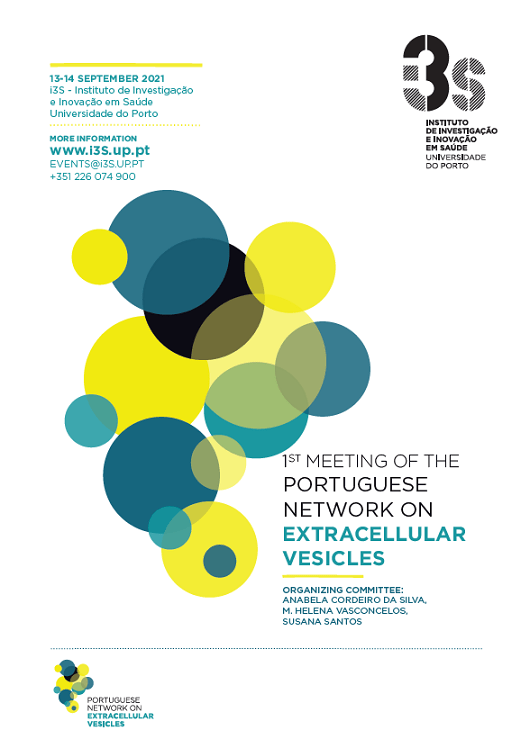
Location: i3S, Porto, Portugal
Dates: 13th-14th of September 2021
Registration:
early registration: 23rd July 2021 (students 60 EUR, others 120 EUR)
regular registration: 1st September 2021 (students 100 EUR, others 240 EUR)
The meeting is organized in four sessions: I) Methods for EVs isolation and characterization; II) EVs in infection and immunity; III) EVs in tissue repair; and IV) EVs in cancer.
More information: https://www.i3s.up.pt/event.php?v=178
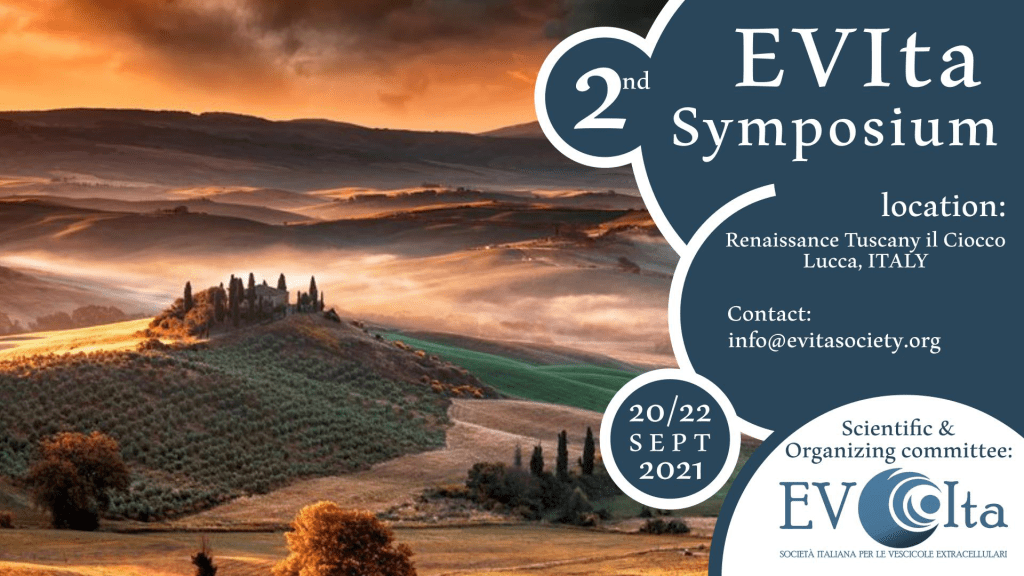
Location: Tuscany, Renaissance Tuscany il Ciocco Resort (in person)
Dates: 20th-22nd of September 2021
Abstract deadline: 22nd of June 2021
Registration (including accommodation, for members of any European EV society):
early registration: 30th June 2021 (junior – 300 EUR, senior 450 EUR)
regular registration: 30th July 2021 (junior – 400 EUR, senior 600 EUR)
More information: https://evitasociety.it/symposium/
Lepo vabljeni na 1. seminar mreže SiN-EV, ki bo potekal v četrtek, 15. aprila, ob 14h. V okviru seminarjev bodo člani SiN-EV predstavili svoje delo ali izpostavili vidnejše objavljene raziskave iz področja zunajceličnih veziklov.
Seminar bo organiziran preko orodja Webex, do katerega lahko dostopate preko spodnje povezave:
https://medicinskafakulteta.webex.com/medicinskafakulteta/j.php?MTID=mb28163639797e90204a6c5562e8062f2
Meeting number (access code): 121 548 0267
Meeting password: 5Ym6CPTPuM6
Program:
14.00 – 14.20 Vpliv hormona gastrina na izločanje zunajceličnih veziklov iz celične linije raka želodca
Pia Pužar Dominkuš; Medicinski Center za Molekularno Biologijo, Inštitut za Biokemijo in Molekularno Genetiko, UL Medicinska fakulteta
14.20 – 14.40 Karakterizacija majhnih zunajceličnih veziklov pri bolnikih z antifosfolipidnim sindromom
Ula Štok; Fakulteta za Farmacijo, Univerza v Ljubljani ter Klinični oddelek za revmatologijo, Univerzitetni Klinični Center Ljubljana
14.40 – 15.00 Analiza miR-9-5p, miR-124-3p, miR-21-5p, miR-138-5p in miR-1-3p in njihovih tarčnih genov v glioblastomskih celičnih linijah in majhnih zunajceličnih veziklih
Alja Zottel; Medicinski Center za Molekularno Biologijo, Inštitut za Biokemijo in Molekularno Genetiko, UL Medicinska fakulteta
My name is Alja Zottel and I am postdoc researcher in prof. Komel lab at the Medical Centre for Molecular Biology, Institute of Biochemistry and Molecular Genetics, UL MF. I am working in the field of exosomes in glioblastoma, especially exosomes as a delivery system. Glioblastoma, the most common primary brain tumor, is one of the deadliest cancers. It is characterized by highly immunosuppressive nature that significantly contributes to the malignancy of the disease. Therefore, I was excited to read more about the role of exosomes in glioblastoma immunosuppression in the manuscript by Azambuja et al., recently published in Neuro-Oncology Advances (https://doi.org/10.1093/noajnl/vdaa056).
The authors showed that exosomes carry several inhibitory proteins, such as FasL, TRAIL, CTLA-4, CD39 and CD73. In vitro, exosomes suppressed the activity of different immune cells and were able to polarize M1 macrophages towards immunosuppressive M2 phenotype by modulating NF-κB pathway. The scientists also examined the effect of exosomes in vivo and showed they decreased the number of M1 macrophages and increased the number of M2 macrophages in mice. The results overall illustrate that glioblastoma-derived exosomes stimulate immunosuppression of the tumor.
By Alja Zottel.

